Switchboard began as a different idea: everyone streams, and the switch cuts to whoever is doing something worth watching. What is built today is the first honest piece of that, aimed at one venue. The argument is that every streaming product adds choice and this one removes it, because nobody wants to be their own editor, and the standard doing that job is something you can read, cite and argue with. It is a prototype: it has not run at a real venue yet and there is no consent flow.
Nobody wanted to be their own editor
The idea before it had a name
It started as a different app. One person joins and streams. A second person joins, and it cuts to whoever is doing something more interesting. A third joins. Eventually a thousand people are streaming at once and everybody in the world is watching the same one thing: someone at a race, someone at a party, someone doing something deliberately strange because strange wins the cut.
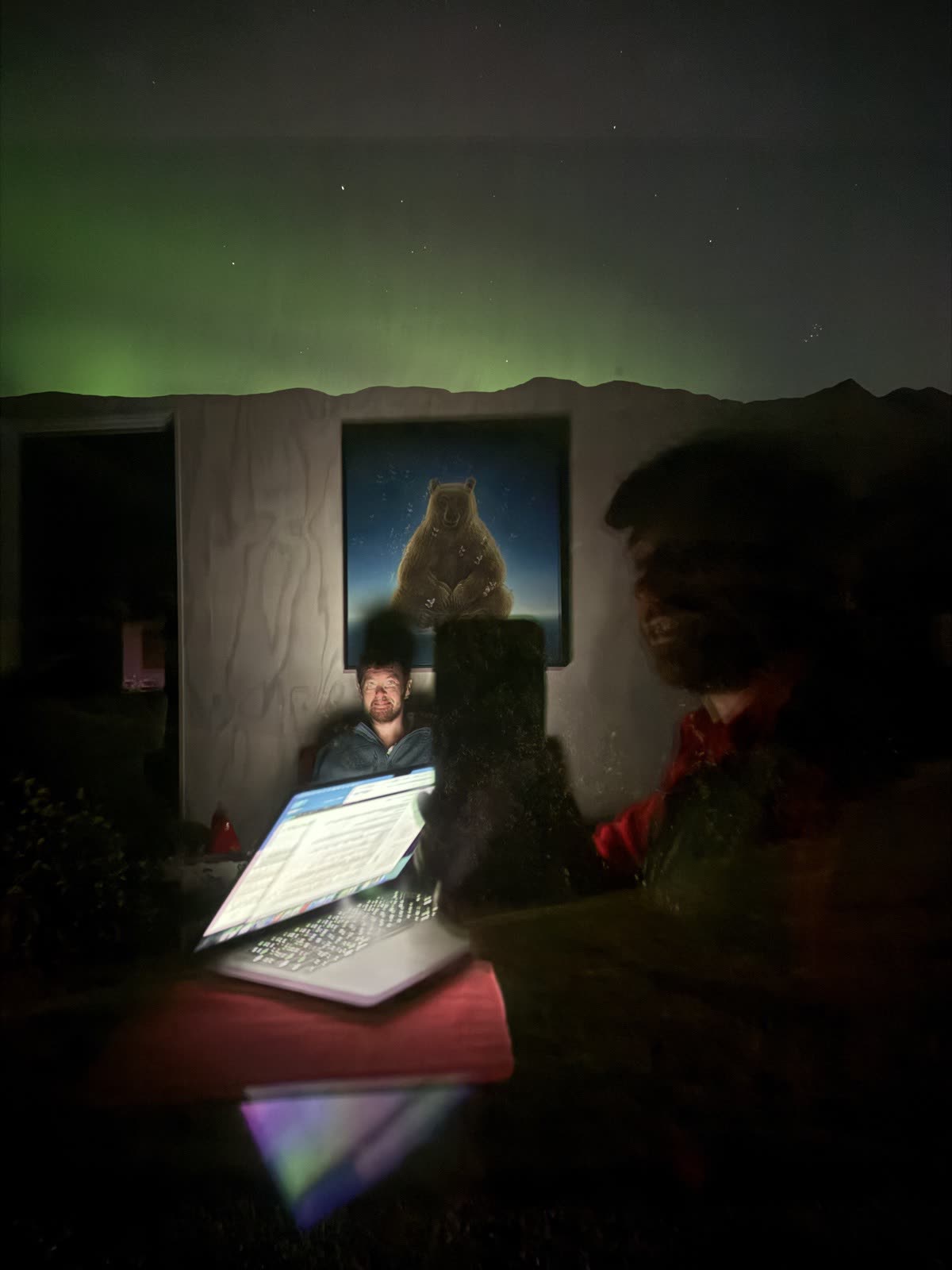
We described it that night as real-time Arctic Entries. Everyone tells a story. The switch decides who has the floor.
That is still the idea. What is built today is the first honest piece of it: one venue, several phones, one feed out. The rest is the argument for why the piece is worth building.
Everybody else gives each person a channel
Every streaming product ever shipped gives you more: more feeds, more choice, a better guess at what you personally want, and in the end a channel of your own that only you are responsible for. Switchboard goes the other way. A channel here is one feed that many people point cameras at, and everyone watching it sees the same thing or sees the slate.
That sounds like a limitation. We think it is the point. Somewhere in the pursuit of giving each person their own channel, we made everyone responsible for building their own broadcast, all day, forever.
Ask someone why they quit a feed they used to love and eventually you get a version of the same answer: they didn't want to be their own editor. Which is not a request for somebody else to decide for them. It is a request for the deciding to be done somewhere they can see it.
Doing that job well is real work, and nobody signed up for it. Switchboard's answer is that the standard does the job, and you get to read it. Not a policy page written after the fact: the actual constants the gates apply, served as JSON, versioned, and frozen per version, so a ruling made today still resolves after the rules change. Every clause has a stable id that a refusal cites. You can argue with it.
The slate is the product
When no stream clears the bar, everyone sees a blue screen.
That screen is the only part of this that cannot be faked. Every outlet has an editorial bar, and almost none of them will show it to you, which makes it unfalsifiable: you are asked to believe there is a line and that things fall on the wrong side of it sometimes. Ours is a blue screen anyone can see on a Friday night. A human director cannot override it. The refusal is the feature.
We took the design from public access television, which had the shape right fifty years ago: the community produces, an institution sets the bar and distributes. The service listens on port 1972, the year the FCC first required cable systems in major markets to carry public access channels. The analysis sidecar binds 1934, the year the Communications Act created the FCC and with it the public interest standard this is all an argument about.
Nobody appointed us
The obvious objection, and it is the right one: switchboard decides what airs and nobody elected it. Every argument above for a published bar is also an argument that somebody is holding one, and a community switcher answering to no one is a gatekeeper with better paperwork.
The problem was never that nobody chooses. Something chooses already, continuously, and will not show its work. Every feed anyone has is curated against an objective they cannot read, by a process with no appeal.
If choice were absent, the fix would be to appoint an editor, which is exactly the gatekeeper move. The chooser is hidden, so the fix is to make its standard legible and arguable instead. That is the whole of what is built here: the rules, versioned, frozen per version, served as JSON, every clause carrying an id a refusal cites.
And the human power here only runs one way. A director can put the blue screen up at any moment, for any reason, with no condition on it at all. What a director cannot do is put material to air that the gates refused.
Ask for a stream whose picture they refused and the request is simply declined. Ask for one whose sound they refused and it goes out silent, because a refused sound is not a reason to lose an acceptable picture and it is not a reason to broadcast the sound either. Nobody at this end can be talked into broadcasting something. They can only ever be talked into broadcasting less.
And none of it is imposed on anybody. A venue points this at its event or does not. There is no network to be carried on, no franchise, no licence for anyone to revoke. The bar is offered, and the worst it can do to a person is decline to broadcast them, in public, citing a rule they can read and argue with.
The same argument, sung
Everything above, at 96 BPM, over a Rhodes piano and tape hiss. It is a real song and it makes the case better than the prose does in one place: the bridge is about what a refusal is for.
And I used to think a
nowas a door slammed shut,
a failure of nerve, a coward's cut.
Then the screen went blue, and I finally saw:
thenois the only proof there's a law.
And in the middle of it everything stops, for a bar, and one voice reads
out a clause id and a fate:
visual.not-the-event,
held off air. That is a real rule with a real id on
the standard page, which is the point: a refusal you can look
up is a different object from a refusal you are asked to accept.
Built in Alaska, over a weekend, after a phone call
We are Geeks in the Woods. Switchboard was built in Valdez over a weekend, starting the night after a call with someone in Anchorage about an entirely different product, which is how most of this goes.
That call was on a Friday night for the ordinary reason: Valdez to Anchorage is most of a day around Prince William Sound. The conversation happens over a laptop or it does not happen at all. Everyone here already understands that being somewhere is expensive, and that most of what happens in this state happens in rooms nobody can get to.
Which is the other half of the problem. Following your own local government here means flying to the room or catching a broadcast that does not exist: a borough assembly, a city council, a school board, a village council. Most of them are never streamed by anybody, and the ones that are get streamed by whoever happened to be in the room with a phone.
Three people in a room with phones is not nothing. It is, in most of this state, everything there is. Switchboard is a bet that you can take those three feeds, check them against a published bar, and put out one that holds up, or put out the blue screen and be honest about it.
The version of this we would rather build
Everything above aims at a game, and a game is the version with the hardest problems. A different room makes several of them disappear at once, and it is the room Alaska actually needs covered: a borough assembly, a city council, a school board, a village council meeting.
Consent stops being a blocker, structurally rather than by policy. Adults speaking on the record at an open public meeting are already being recorded, already in public, and already understood to be. The reason this should not be pointed at a school game is that the people in frame have not agreed to be broadcast. At a public meeting they have, by being there and speaking.
The delay stops costing anything. Sixty seconds behind live is a real trade at a basketball game, where somebody in the room is watching the same moment happen. Nobody needs a borough assembly in real time. The hold that makes the picture and speech gates preventive rather than retrospective becomes free.
And the picture gate gets easier, not harder.
visual.not-the-event asks
whether the
camera is doing its job. A council chamber is a fixed room with a table and people
talking at it, which is a far easier thing to rule on than fast motion across a court
under bad gym light.
And the material is already in the room. These meetings are public by law and unwatched in practice, and the only cameras that will ever be at most of them belong to the people who turned up. That is the same bet as the gym, made in a room where the two hardest problems have already gone away.
Stated as intent, not as a feature. Nothing here has been pointed at a meeting, the consent reasoning above is ours rather than a lawyer's, and open-meeting law differs by state and by body.
Consent, and what the standard says about minors
The gap here is consent, not minors. The standard already carries a clause protecting a minor from being named in a negative, accusatory, mocking or sexualised way, and nothing in it refuses a school game. What is missing is a consent flow for anybody who ends up on camera, which is as true of an adult rec league as of a school one, and until it exists this should not be pointed at an event where the people in frame have not agreed to be broadcast.
The footage the picture gate was measured on is a different matter and is why the figure can be published at all: it is public-access archive that already aired, licensed to permit adaptation, so testing against it points a camera at nobody.
Where it actually is
Switchboard was started on 28 August 2026. A phone has published to it, cleared all four gates and reached air, which is the whole chain working once. It has not run at a real venue yet, and 1 of the 17 thresholds on the standard page is measured rather than chosen ahead of a field test, which the page marks one by one. Treat anything describing it as a running service as wrong.